Concept and Methodologies
In line with the principles of the EUCloudEdgeIoT Initiative, the MYRTUS Reference Infrastructure and the MIRTO Cognitive Engine realise a seamless integration environment, including heterogeneous resources, while being compatible with already available infrastructures. The MYRTUS Design and Programming Environment represents the instrument needed to design, deploy, and operate such a seamless and diverse continuum. The proposed technologies enable the emergence of CPS with a living dimension. MYRTUS follows a two-phase iterative approach of 18 months each: the first phase delivered and assessed the first version of MYRTUS technologies and gathered feedback from communities and stakeholders; the second phase builds on this feedback to finalise the technologies and integrate them across the whole edge-fog-cloud continuum.
The three MYRTUS technology pillars
The ambition of MYRTUS is to provide the technology for a composable edge-fog-cloud computing continuum, integrating heterogeneous computing nodes, managed by a cognitive engine and supported by a design and programming environment, to address the needs of complex and dynamic systems in an energy-efficient and trustworthy manner.
MYRTUS technology results are organised around three pillars. Pillar 1 provides the edge-fog-cloud reference infrastructure on which applications run, together with the cross-cutting aspects (networking, privacy and security, trust, data management) that support its operation. Pillar 2 provides MIRTO, the cognitive engine that orchestrates workloads across this infrastructure, deciding where and how each workload is placed and executed. Pillar 3 provides the Design and Programming Environment (DPE), the methodology and toolchain through which applications are developed, optimised and packaged for deployment.
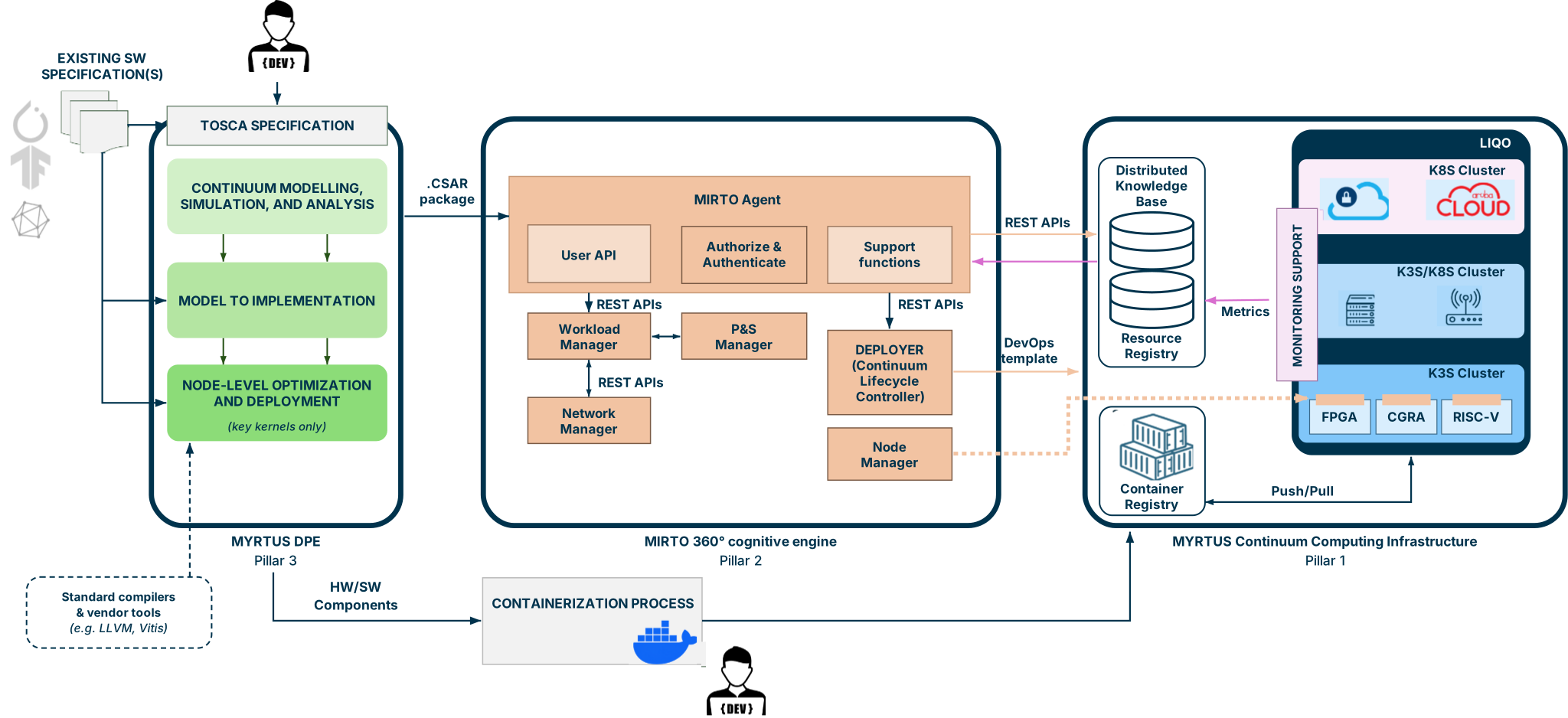
The three pillars form the technological chain illustrated in the figure. The DPE provides developers with the environment to design, program and prepare an application for deployment, producing a TOSCA model that describes the application, its requirements and its deployment points, as well as the HW/SW components implementing it. These components are packaged into a container image, made available to the infrastructure through a container registry. The TOSCA model is ingested by MIRTO, which validates it against the MYRTUS trust requirements, computes an allocation map, and generates the corresponding deployment manifests for the reference infrastructure, where the registered image is then deployed. The infrastructure, in turn, continuously feeds resource and telemetry information back to MIRTO through the Distributed Knowledge Base, closing the loop and allowing MIRTO to adapt workload placement over time.
MYRTUS knowledge, data, and technology sharing
OPENNESS
Open source guarantees the support of the community built behind the technology and eases customisations and third-party extensions. Open-source HW platforms and template architectures, open-source functions and algorithms, and open-source tools and frameworks facilitate the uptake of MYRTUS results (see Developments).
INTEROPERABILITY
MYRTUS provides an MLIR-based interoperability framework for node-level optimisation and code generation, facilitating system integration and easing migration among devices, as well as interoperability with third-party solutions (e.g., importing models from PyTorch, TensorFlow and ONNX). At design level, applications are described with the OASIS TOSCA standard, so that their topology, requirements and policies are carried from design to deployment. At the orchestration level, a common information model and a Distributed Knowledge Base shared across the continuum layers allow distributed monitors and AI-powered managers to exchange information across layers.
PORTABILITY
MYRTUS exploits container- and Kubernetes-based solutions (lightweight K3s at the edge, standard Kubernetes at the fog and in the cloud), federated through Liqo across sites and administrative domains, to support portability on already existing systems without completely changing the computing layers. This allows portability over legacy systems, supporting the use of existing infrastructure leveraging principles of the “sharing economy” and pursuing, in turn, sustainability.
Adherence to the sustainable and responsible computing paradigm
OBSOLESCENCE AVOIDANCE
Supported by MYRTUS principle of openness, interoperability, and portability.
HW reconfiguration: Reconfigurable computing approaches and the use of FPGA-based HMPSoCs offer customization while keeping the benefits of general-purpose multicore tightly coupled to the reconfigurable logic. These platforms facilitate long-term maintenance and on-demand update using Over-The-Air-like approaches without changing the basic boards.
Legacy systems compliancy: Part of the MIRTO cognitive engine is platform dependent, but the formalisation of the cognitive self-adaptation loop, provided as a template based on a set of reusable solutions, and the use of widely adopted technologies such as TOSCA and Kubernetes ease implementation and solution porting also on legacy systems. Thanks to these, any substrate can be included or become a MYRTUS-compliant system.
RESOURCE SAVING AND ENERGY EFFICIENCY
Supported by HW specialisation and optimization techniques.
HW specialisation: MYRTUS provides: 1) template architectures for specialised run-time reconfigurable HW, to deploy HMPSoCs on FPGA; 2) adaptive RISC-V processors coupled with specialised CGRA accelerators, leveraging open and extensible computer architectures. Heterogeneity and specialisation are made transparent to programmers through automatic and efficient SW-to-HW code offloading. Measured speedups on the MYRTUS edge accelerators reach and exceed one order of magnitude with respect to software-only execution, with energy savings proportional to the speedup.
Optimization techniques: The MYRTUS DPE explores deployment alternatives and node-level HW-SW mappings, featuring device-specific optimisations for figures such as energy consumption and performance. At runtime, MIRTO provides 360° energy-aware orchestration: its managers take energy into account when placing workloads, and on FPGA-based nodes the Node Manager adapts the node configuration to save energy. Node-level energy monitoring is also available at the fog layer. Shifting services more towards fog/edge also lowers dependency on big data centres.