MYRTUS and EU-CEI
From EU-CEI building blocks to a design-to-runtime continuum
From its first months, MYRTUS has used the reference architecture of the European Cloud, Edge and IoT Continuum initiative (EU-CEI) as the guideline for its technologies. The project has turned the EU-CEI building blocks into working technologies and extended them with a design and programming environment that the reference architecture does not cover.
The EU-CEI initiative
The EUCloudEdgeIoT initiative brings together research projects, developers and suppliers, business users and potential adopters of the cloud-edge-IoT continuum, to define a common, coordinated strategy for its design and development. One of its technical goals is a reference architecture for the continuum, to be promoted as a standard. The initiative's Architecture Task Force has defined its concept, taxonomy and building blocks: the technical processes needed to operate applications along the continuum.
MYRTUS joined the initiative in January 2024, when the project started, and is part of its community of Cognitive Computing Continuum projects. Events, talks and other community activities are listed on the Synergies page.
How MYRTUS builds on the reference architecture
Adopt
MYRTUS studied the EU-CEI reference architecture from the start and adopted its building blocks as the set of functions its continuum has to provide. The first alignment was set out in the project's requirements (D1.1), as a first step towards standardising MYRTUS technologies.
Realise
The work of all three pillars has been carried out with this alignment in view. Each building block is now implemented with concrete MYRTUS technologies, running on a federated edge-fog-cloud infrastructure that spans several partner sites.
Extend
Heterogeneous hardware such as FPGAs, CGRAs and RISC-V processors needs more than the functions of a running continuum. MYRTUS adds the Design and Programming Environment (DPE), which turns applications into implementations ready for this hardware.
The building blocks in MYRTUS
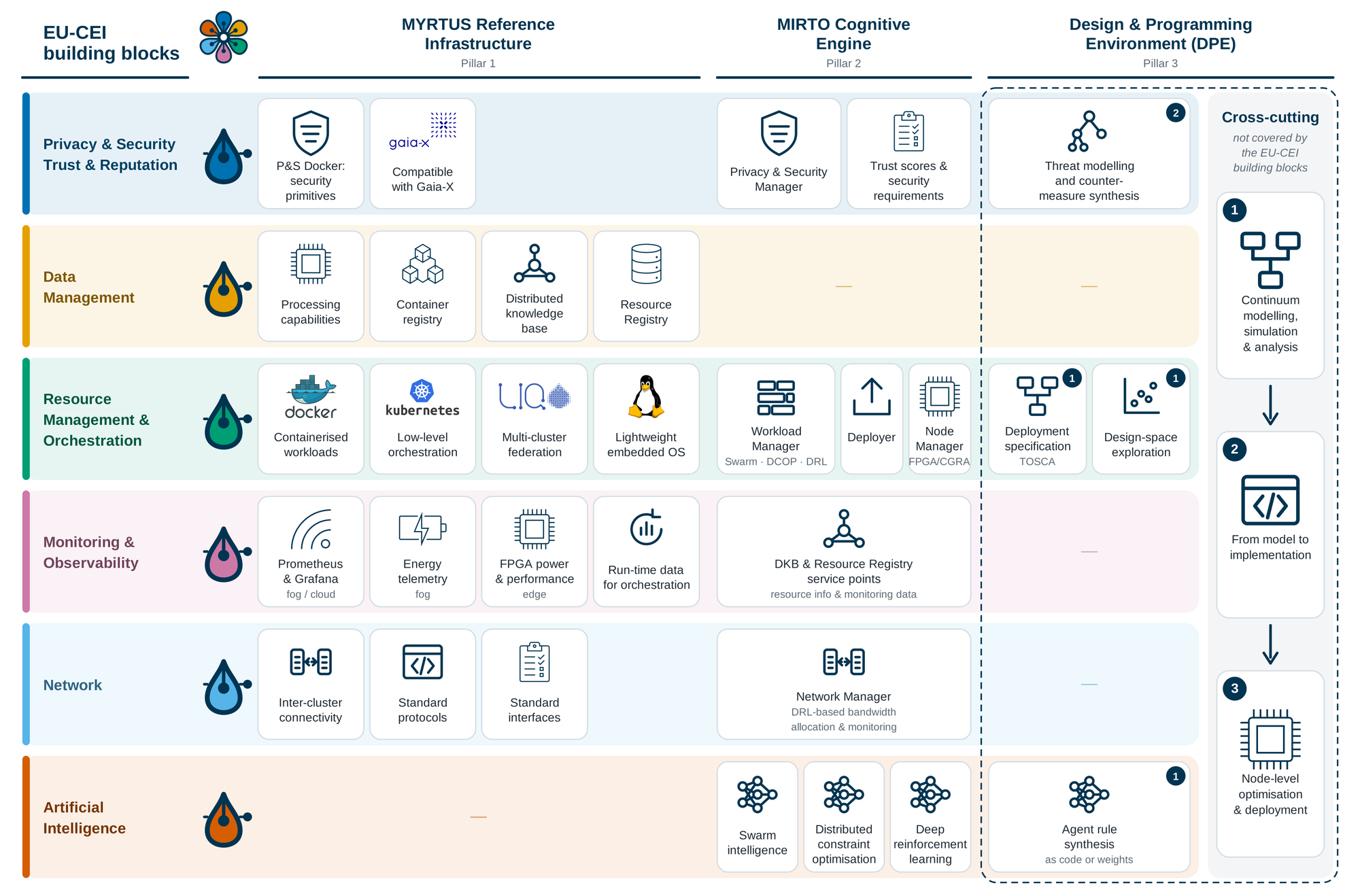
The figure shows how each EU-CEI building block is realised in the three MYRTUS pillars, and where the DPE extends them.
Privacy & Security, Trust & Reputation
Security primitives at three security levels, packaged as containerised modules. The Privacy & Security Manager recommends suitable nodes, tracks their trust and switches primitives at runtime. A compliance service based on the Gaia-X Trust Framework is designed for cluster onboarding. At design time, threats are modelled and countermeasures synthesised automatically.
Data Management
A Distributed Knowledge Base and a Resource Registry share resource status and monitoring data across the continuum layers, while a container registry holds the application images. Each layer processes data according to its role, from real-time processing at the edge to long-term storage in the cloud.
Resource Management & Orchestration
Kubernetes manages each cluster and Liqo federates clusters across layers and sites. MIRTO decides where workloads run, with workload managers based on swarm intelligence, distributed constraint optimisation and deep reinforcement learning; its Node Manager handles FPGA and CGRA nodes. The DPE provides TOSCA deployment specifications and design-space exploration.
Monitoring & Observability
Prometheus and Grafana at the fog and in the cloud, node-level energy telemetry at the fog, and a dedicated power and performance monitoring framework for FPGA-based edge nodes. All runtime data is made available to MIRTO through the Distributed Knowledge Base.
Network
Inter-cluster connectivity through Liqo, over encrypted tunnels, and standard protocols and interfaces such as HTTP and MQTT between components. The MIRTO Network Manager allocates bandwidth to communication flows.
Beyond the building blocks: the DPE
The EU-CEI reference architecture describes the functions a continuum offers. It does not address how an application becomes an executable implementation. This is already demanding on heterogeneous families of CPUs, and becomes harder as hardware accelerators are introduced. Since MYRTUS-compliant infrastructures include FPGA, CGRA and RISC-V nodes, a design and programming environment with cross-platform support is a building block in its own right.
The MYRTUS DPE covers this need in three steps, connected through open standards such as OASIS TOSCA and MLIR:
Continuum modelling, simulation and analysis
The application topology, its policies and constraints are modelled and evaluated before deployment.
From model to implementation
Models become deployable components, with security countermeasures synthesised for the threats identified.
Node-level optimisation and deployment
Key kernels are compiled and optimised for CPUs, FPGAs, CGRAs and RISC-V processors.
The DPE also feeds the other building blocks: its deployment specifications and agent rules are used by MIRTO for orchestration and AI-driven placement, and its threat models drive the security functions deployed at runtime.
MYRTUS in the EU-CEI community

MYRTUS Intermediate Event
✨ Live demonstrations from the MYRTUS project
✨ Posters & contributions from related initiatives
✨ A relaxed, interactive format to encourage networking, discussion, and collaboration

Towards standardization: Alignment with EU-CEI
During the first year of the the project, we made the effort to frame the MYRTUS technologies in the context of the EUCloudEdgeIoT reference architecture.

NexusForumEU
Presenting “MYRTUS, a Computing Continuum Ecosystem Leveraging AI Technologies” at the NexusForumEU 2024.

Innovating the Edge to Cloud Continuum
MYRTUS is at the forefront of creating cutting-edge solutions. Read the interview from our Coordinators in the INSIDE Magazine.

Winner of the 2024 RIAs Challenge
MYRTUS received a customised reward from the INSIDE IA, in the context of the 2024 RIAs Challenge organised by EUCloudEdgeIoT.