
Mobility use case
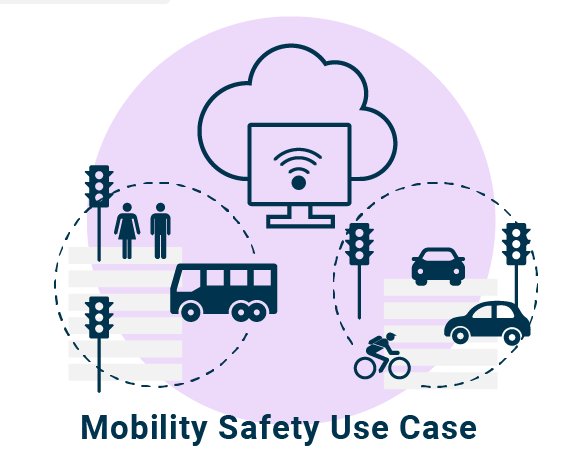
Fig. Intersection Safety
MOBILITY USE-CASE
Intersection Safety
Managing traffic safety at road intersections will become increasingly more complex and adaptive with the deployment of CCAM. In addition to traffic rules and traffic light controllers, roadside systems will autonomously communicate and cooperate intensively with AVs, VRUs with personal devices, and traffic safety and information services in the cloud. Roadside systems will need to be more reliable and accurate to detect and predict imminent conflicts such as red-light violations and collisions with VRUs. Connecting AVs to each other and to the infrastructure allows for collaboration on the perception of other road users (Collective Perception Messages services) to improve perception performance and reduce occlusion effects, and coordination of intentions and manoeuvres (Maneuver Coordination Message services) in order to prevent or mitigate potential safety hazards. This requires continuous adaptation and learning in a constantly changing environment with endless safety critical scenarios that could occur. Depending on the traffic situation, computational tasks can be relatively simple, or extremely complex. Dynamic offloading of tasks from edge to fog or cloud can ensure these tasks can always be performed whilst alleviating the computational burden for the different edge/fog/cloud components. It also allows sharing the “lessons learned” across all other smart infrastructures. Indeed, this kind of CPS is meant to become a living one with continuous exchange, both at the infrastructure level and with users in a seamless manner and learning processes. MYRTUS technologies will enable a next evolution in CCAM with the ability to advise and coordinate manoeuvres to avoid collisions.