Organizer: Discover US
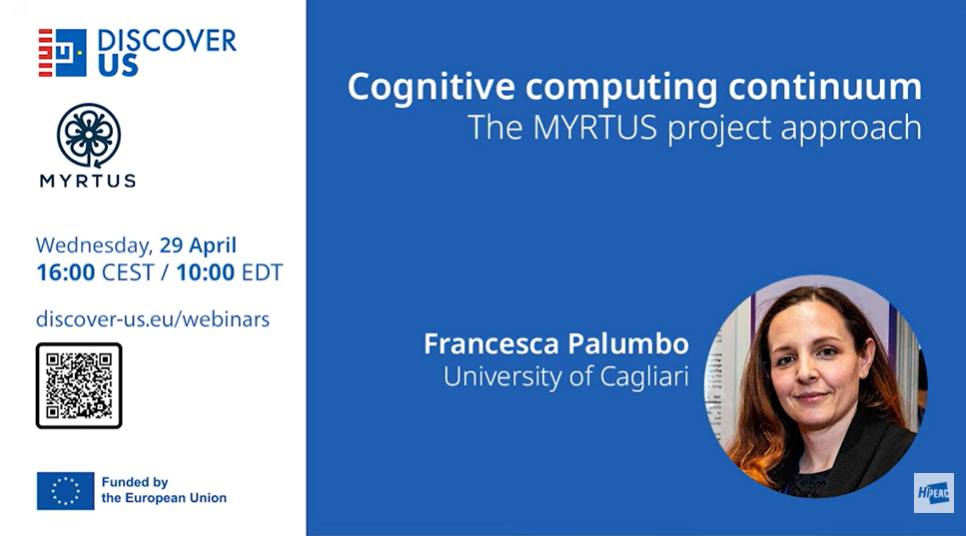
Date: 29/04/2026
Place: Online
Link: https://discover-us.eu/webinars/#/
Giving a webinar with the title “The MYRTUS approach to the cognitive computing continuum”
On Wednesday 29 April 2026, at 16:00 CEST, Francesca Palumbo (University of Cagliari), Scientific Coordinator of MYRTUS, gave the webinar “Cognitive computing continuum: The MYRTUS project approach” in the DISCOVER-US webinar series. The recording is available on HiPEAC TV.
The growing complexity of cyber-physical systems is pushing computing beyond isolated edge, fog or cloud deployments. Today these layers are often managed as separate silos. The webinar explained how MYRTUS federates heterogeneous resources into a single computing continuum, with the fog layer acting as a bridge between edge and cloud, and how it manages them dynamically at runtime across all layers.
The talk walked through the three pillars of MYRTUS. The first is a federated multi-layer infrastructure, which combines edge nodes with FPGA accelerators and RISC-V processors, a smart gateway and a Fog Micro Data Centre at the fog layer, and existing cloud resources, all virtualised as one Kubernetes continuum through Liqo. The second is MIRTO, the AI-powered cognitive engine, which decides where workloads run by balancing performance, energy efficiency, security and privacy. It offers three workload managers, based on swarm intelligence, distributed constraint optimisation (DCOP) and deep reinforcement learning. The third is the Design and Programming Environment, which takes applications from high-level models to deployment using open standards such as TOSCA and MLIR.
Francesca Palumbo also showed how MYRTUS builds on the building blocks of the EUCloudEdgeIoT reference architecture and on the principles of autonomic computing, with self-adaptation loops that reconfigure both software and hardware. In the Q&A, she explained how energy and latency metrics are collected from FPGA edge nodes to feed the MIRTO workload managers, and how the MIRTO Agent is designed to validate credentials against the Gaia-X Trust Framework.
